
While the right wing pundit worry factor is rising, there still seems to be near unanimous agreement that Donald Trump will not be the nominee of the Republican party this election. So, it’s worth asking: Just how hard, how fast and how far must Trump fall to blow this thing? Inquiring minds want to know. Well, take a look at this graph.

It shows the national polling for two GOP front runners for this election and the two previous: McCain (blue) and Giuliani (yellow) in 2008; Romney (grey) and Gingrich (green) in 2012; and Trump (red) and Cruz (black) this year. The timeline is adjusted to reflect days out from and days after Iowa. So, -2 is two days before, 1 is the day after, etc.*
Today we are at Day Iowa-28 (4 weeks out from the caucuses), but because of the holidays, our last glimpse of polling numbers are from December 23 (Day Iowa -40). Based on the last two elections, you can see that being the front runner 30 days out offers no real advantage in the long term chase for the nomination. Four years ago, Gingrich was leading Romney at this point, and in 2008, Giuliani was well ahead of McCain who was polling in the low teens. But Giuliani was well into his slide and eventual demise at this point, and Gingrich was just starting his downhill run.
Right around day zero, that is the Iowa caucuses, everyone seems to converge. Then the eventual nominees begin their steady if rocky climbs. Rocky for McCain because Huckabee made a semi-run at him down the road from here; and for Romney because Santorum was yet to surface as his last major contender (last of a series of brief candles–Perry, Cain, Gingrich being the others). And that’s where this year differs from the last two elections.
Trump has held his commanding lead since about July, shortly after he announced. He has to fall farther, faster, harder than any previous contender in recent history. And what might precipitate such a fall? Republican voters have already seen the worst of him. Provided he doesn’t completely collapse in the three weeks between Day Iowa-7 and South Carolina, he’ll be in it to stay.
And what of Ted Cruz? Does his trajectory go the way of McCain or Huckabee?
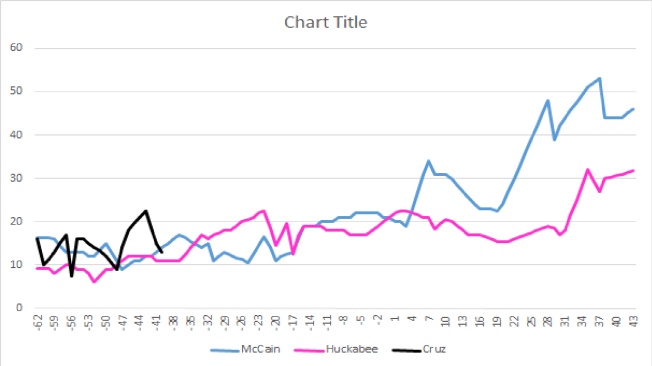
Or none of the above? You can see Huckabee got virtually no bump nationally from his win in Iowa (and Cruz won’t either if he continues to lead in the polls there prior to Caucus Day), while McCain did get one from his New Hampshire win. His second bump, around Day 28, came from his Florida win and Giuliani’s withdrawal. Huckabee’s only real bump (Day 35) is from Romney’s withdrawal.
With McCain, the heir apparent, once he had proven himself to be a winner, the voters clambered aboard. That’s not likely to happen with an insurgent candidate like Cruz–at least not out of the first four primaries, or Super Tuesday–because he’s not the foregone conclusion that McCain was. He’ll need to be become the inevitable choice through wins in big northern, less conservative states and by racking up a ton of delegates along the way. Even Santorum in 2012 managed wins in Minnesota, Missouri and Colorado fairly early on, but he was unable translate that into a broader appeal. Of course, if he manages to sweep the first four (IA, NH, SC, NV), that’s a different story.
*A word about the data set: obviously, there weren’t polling results released everyday so figures between dates of polls were interpolated to make the Excel line graph function work. The figures are from what’s available at pollster.com and realclearpolitics.com (RCP). They do not reflect the RCP polling averages which, to my mind, reach too far back in time for their data–sometimes several weeks–and are therefore not an accurate reflection of candidates’ standing; nor are they pollster.com’s (more accurate) regression analysis composites. They are just the raw poll numbers.
 The Election Junkie